Why Imperfection Is Back: Patina, Weathering, Craft, and the Rejection of Flawless Architecture
Patina and weathering are returning to architecture. Learn how material aging, craft, durability, and maintenance can shape buildings that improve with time.
START A PROJECT
Planning a new project?
Share your details and we’ll be in touch about your property, renovation, or development question.
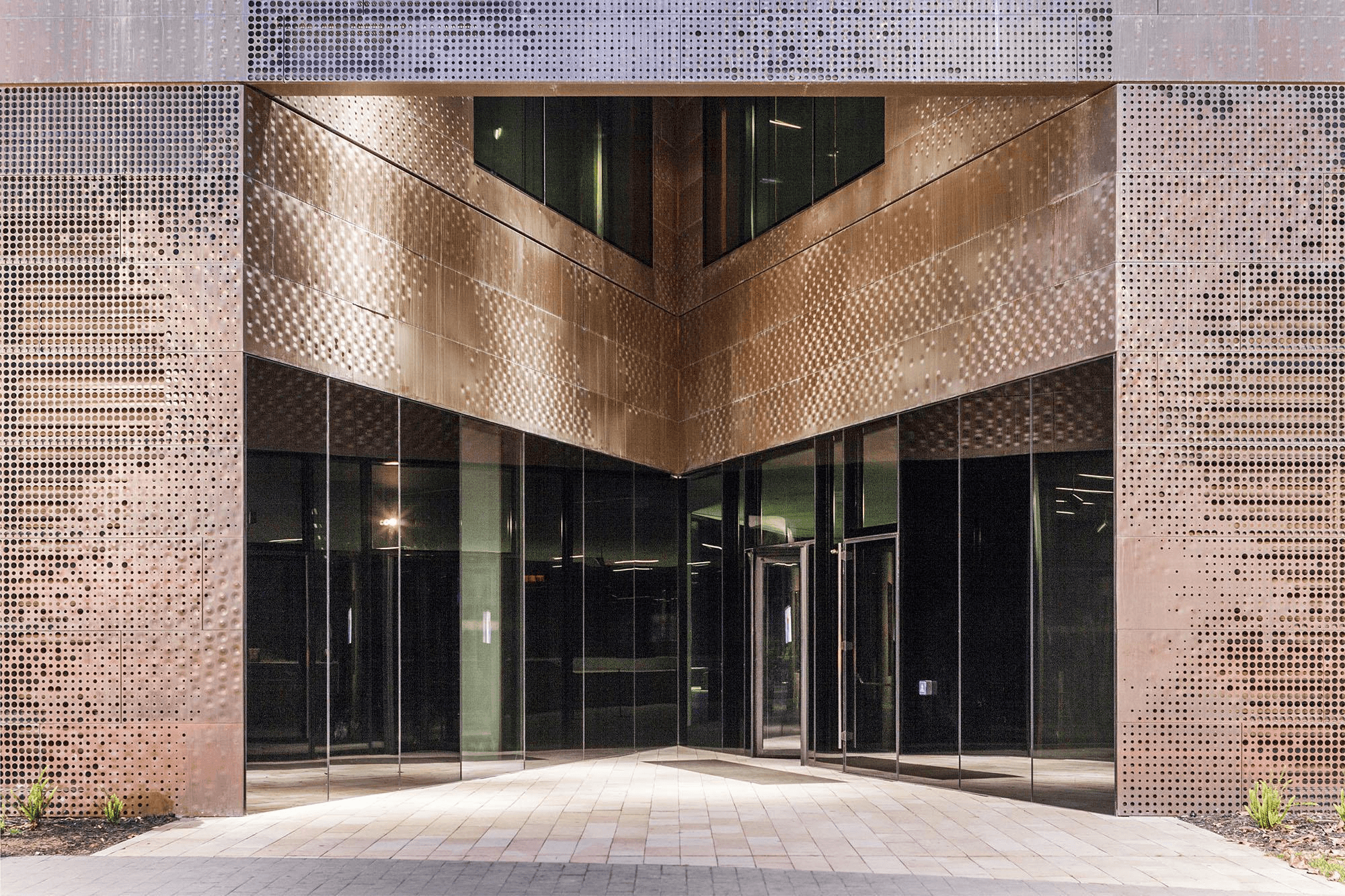
A growing number of architects are designing buildings with materials that are expected to change after construction. Copper oxidizes. Timber silvers. Brick varies from unit to unit. Stone records water and use. Weathering steel develops an oxide layer. Concrete reveals formwork, aggregate, joints, repairs, and traces of construction.
This represents a different attitude toward architectural finish. For decades, many contemporary buildings have been detailed around visual consistency: smooth curtain walls, uniform coatings, concealed fasteners, standardized panels, precise joints, and surfaces intended to remain as close as possible to their appearance on opening day. Those systems can produce excellent architecture, but they also establish a demanding relationship between the building and time. Scratches, fading, staining, repairs, replacement panels, and normal weathering can begin to look like defects because the original design depends on uniformity.
Materials that accommodate aging establish another standard. Their appearance is understood as a process rather than a fixed condition. That does not mean deterioration should be celebrated or maintenance ignored. Patina and material failure are different things. A copper surface changing color through oxidation can be intentional. Water entering behind that copper is a defect. Timber developing a silver-gray surface may be expected. Rot caused by trapped moisture is not. Concrete discoloration may be acceptable while reinforcement corrosion is a structural concern.
For owners, developers, and architects, the useful question is therefore not whether imperfection looks attractive. It is whether the building has been designed to distinguish acceptable change from damaging deterioration, and whether its materials can age in a way that remains technically sound and architecturally coherent.
Patina Is a Material Process, Not a Decorative Effect
The word patina is frequently used as a visual description, but many forms of patina result from physical and chemical processes. Copper provides one of the clearest examples. Newly installed architectural copper has a bright metallic appearance. Exposure to the atmosphere initiates corrosion processes that progressively alter its surface. Research published in Corrosion Science examining natural copper patinas from multiple locations found that atmospheric exposure creates layered corrosion products, beginning with cuprite directly against the copper. Environmental conditions affect the composition and appearance of subsequent layers. This means the familiar green associated with aged copper is not simply a color selected from a finish chart.
The process can vary according to moisture, pollutants, salts, exposure, orientation, and local atmospheric conditions. Different elevations of the same building may consequently weather at different rates. Sheltered areas can remain darker while exposed surfaces change more rapidly. Runoff can carry corrosion products onto neighboring materials.
For a project team, those differences matter. If the design depends on copper eventually reaching a particular appearance, the architect and owner need to understand that the intermediate stages are part of the building's life. The façade may pass through bright copper, brown, dark brown, and eventually green tones over an extended period. Artificially pre-patinated products can provide greater initial predictability, but they create a different material condition from allowing natural exposure to produce the surface.
The same principle applies to many materials. Uncoated metals oxidize. Timber responds to ultraviolet exposure and moisture. Stone can darken where water repeatedly travels across it. Brick contains natural differences in firing, clay, texture, and mortar. Concrete records variations in curing, formwork, aggregate, tie locations, pours, and repairs. When these processes are anticipated, variation can belong to the architecture. When they are not, owners may spend substantial effort trying to restore a degree of visual uniformity the material was never likely to maintain.
The de Young Museum Was Designed to Change Color
Herzog & de Meuron's de Young Museum in San Francisco provides an unusually clear example of weathering being incorporated into architectural intent. The museum's exterior is wrapped in perforated and embossed copper panels. Herzog & de Meuron developed the façade through extensive experiments with copper sheeting, using pixelated images of tree canopies as the basis for its patterns.
Copper was particularly appropriate because the building sits within Golden Gate Park. Rather than maintaining the bright metallic appearance of newly fabricated copper, the material was expected to oxidize and change color. Over time, the building could become visually closer to the landscape around it. The strategy offers an important lesson about material selection. A material can be chosen partly because of what it will become rather than only because of what it looks like when installed.
That changes the way renderings, samples, and client presentations should be approached. A conventional material board typically presents a single finish. A weathering material may require several representations: installation, early exposure, intermediate aging, and mature appearance.
Owners should understand all of them. This is particularly important when appearance affects leasing, branding, public perception, or expectations established during design approvals. A façade designed to weather naturally can look uneven during transitional stages. If that process has not been communicated clearly, normal aging may be interpreted as a construction defect. Designing for patina therefore requires both technical knowledge and expectation management.
The Difference Between Patina and Damage Has to Be Designed
Romanticizing weathering can create serious problems. Buildings are exposed to water, ultraviolet radiation, temperature change, salts, pollution, biological growth, abrasion, freeze-thaw cycles, and countless other conditions. Some changes are superficial. Others indicate failure. The Salk Institute in La Jolla illustrates the complexity.
Louis Kahn's 1965 complex uses concrete and teak window-wall assemblies to establish one of its defining material relationships. After nearly fifty years in a marine environment, however, the teak assemblies had developed significant problems.
The Getty Conservation Institute reports that the wood exhibited non-uniform weathering, surface erosion, fungal biofilm, changes in color associated with previous sealers and finishes, insect infestation, and air and moisture infiltration. The deterioration was serious enough that total replacement had initially been considered. The eventual conservation program demonstrates why material aging requires diagnosis rather than visual judgment.
Getty, the Salk Institute, and their consultants conducted historical research, condition surveys, inspection openings, wood and fungus identification, laboratory analyses, and trial mockups before developing the repair strategy. Approximately two-thirds of the original Southeast Asian teak was ultimately conserved rather than replaced. The project shows that an aged surface can contain several conditions simultaneously.
Some variation may be an acceptable consequence of exposure. Some may be evidence of inappropriate previous treatments. Some may indicate moisture problems or biological deterioration requiring intervention. An architect or owner cannot reliably distinguish those conditions from aesthetic preference alone.
This is why maintenance planning matters from the beginning. If a project intentionally uses materials expected to weather, the design team should establish what normal aging looks like, what conditions require investigation, how surfaces should be cleaned, what treatments should be avoided, and how repairs should be executed. The goal is not to prevent change. It is to manage the difference between change and failure.
Craft Makes Variation Legible
The renewed interest in weathering is closely related to another architectural shift: the return of visible craft. Industrial construction depends on repetition, standardization, tolerances, prefabrication, and quality control. These systems have allowed buildings to become larger, faster to assemble, and increasingly precise.
Craft introduces another kind of precision. A brick wall contains repeated units, but its final character depends on coursing, mortar joints, cutting, corners, openings, bonding patterns, dimensional coordination, and the work of individual masons. Board-formed concrete records the dimensions and texture of its formwork. Stone reveals geological variation. Timber contains grain, knots, and differences between pieces. These characteristics make construction visible.
The Royal Institute of British Architects identifies craftsmanship, local materials, clarity of construction, and simplicity as central principles of the Arts and Crafts movement. The movement emerged partly in response to industrialization and the loss of traditional craft skills. Contemporary architecture operates under entirely different technological and economic conditions, but the renewed interest in craft has a related motivation.
Highly standardized construction can make the process of building disappear behind the finished surface. Materials associated with craft often do the opposite. They reveal joints, assembly, thickness, texture, labor, and differences between individual pieces. That visibility can give buildings greater tolerance for change. A small variation in brick color may reinforce the character of a masonry wall. The same degree of variation across a highly uniform painted metal panel system may appear to be a manufacturing error. Material character therefore affects how imperfection is perceived.
Brick Demonstrates How New and Old Can Share a Material Language
Caruso St John's Newport Street Gallery in London offers a useful example of contemporary architecture working through material continuity rather than flawless uniformity. The project converted three listed Victorian industrial buildings and added new structures at both ends. According to the architects, the new façades use hard pale-red brick selected to closely relate to the surfaces of the existing buildings. The result is a continuous street elevation in which five buildings remain individually distinguishable while clearly belonging to the same composition. The project does not attempt to make new construction indistinguishable from old construction. That distinction matters.
Historic masonry contains decades of weathering, repairs, staining, mortar variation, and environmental exposure that cannot be authentically reproduced simply by selecting a matching brick. Instead, new masonry can establish compatibility through scale, color, proportion, bond, jointing, and construction while remaining visibly contemporary. As the new work ages, the relationship changes again.
This approach can be particularly valuable in additions and adaptive reuse projects. Attempting to reproduce every mark of an older building can produce artificial historicism. Ignoring the existing material character can produce unnecessary contrast. Craft allows a third approach: new construction can be clearly new while using materials and assembly methods capable of entering into a longer relationship with existing fabric.
Durability Is More Important Than Looking New
There is an important economic dimension to the discussion of imperfection. A building that looks pristine on opening day but depends on frequent refinishing or replacement to preserve that appearance may create a very different long-term obligation from a building whose materials tolerate visible aging.
The American Institute of Architects' Framework for Design Excellence asks project teams to consider how long a building will last and how that expected lifespan should influence material selection. Its Design for Resources guidance specifically emphasizes durability, resilience, lifecycle impacts, local materials, and craft as considerations in material decisions.
AIA's guidance on adaptable and long-lasting buildings similarly notes that durable materials can reduce replacement and maintenance demands over a building's life. This does not mean rougher-looking materials automatically last longer.
A weathering material can perform poorly if it is used in the wrong environment or detailed incorrectly. Timber can rot. Steel can corrode beyond intended surface oxidation. Stone can spall. Brick can fail under repeated moisture and freeze-thaw exposure. Concrete can crack and allow water to reach reinforcement. Durability comes from the relationship between material, climate, assembly, detailing, exposure, maintenance, and workmanship. Appearance is only one part of that relationship.
For owners, specifications should therefore address performance and aging together. Samples should be evaluated for how materials will weather. Mockups should test joints, transitions, drainage, fasteners, sealants, runoff, and workmanship rather than simply confirming color. The question becomes whether the building will remain architecturally coherent while performing its technical responsibilities.
Some Materials Require Space to Weather
Material aging is also spatial. Water does not encounter every part of a façade equally. Parapets, sills, reveals, balconies, copings, projections, joints, and recessed surfaces create different exposure conditions. This is one reason apparently simple façades can weather unpredictably.
A shallow projection may direct water onto the surface below. Copper runoff may stain adjacent stone. Deep recesses can remain wet longer than exposed areas. Horizontal surfaces accumulate dirt differently from vertical ones. Drip edges that appear insignificant in an elevation can determine whether rain leaves a controlled line or a broad stain. Designing for weathering therefore requires three-dimensional thinking. The façade should be studied as a system that collects, redirects, drains, dries, expands, contracts, and receives sunlight.
This is particularly important when the architectural concept depends on material aging. A designer may welcome variation while still needing to control where water travels. The objective is not random staining. It is an assembly capable of weathering without compromising performance.
Full-scale façade mockups can be valuable because many of these relationships are difficult to judge from drawings or renderings. They allow teams to examine actual joints, texture, depth, workmanship, and transitions under realistic lighting. For materials with substantial natural variation, the mockup can also establish the acceptable range rather than a single ideal sample.
Digital Fabrication Is Changing What Craft Means
The return of craft does not require a return to preindustrial construction. Contemporary fabrication allows variation and precision to coexist. CNC milling, robotic fabrication, digital modeling, parametric workflows, advanced formwork, laser cutting, additive manufacturing, and computer-controlled masonry fabrication can produce components with controlled differences rather than identical repetition.
Herzog & de Meuron's de Young façade is again instructive. Its perforated copper surfaces were developed from pixelated images of tree canopies. Digital information and industrial fabrication produced a façade whose visual character depends on irregularity and variation. This suggests a broader definition of architectural craft.
Craft can reside in the mason's hand, but it can also exist in the careful translation between digital geometry, fabrication equipment, material tolerances, installers, and finished assembly. What matters is whether the process produces meaningful material specificity rather than variation for its own sake. Digital tools make flawless repetition easier than ever. They also make controlled difference increasingly practical. Architecture can use both.
Repair Can Become Part of a Building's Material History
Buildings inevitably require repair. Sealants fail. Masonry cracks. Wood checks. Metal is scratched. Stone is chipped. Mechanical penetrations are added. Tenants alter interiors. Waterproofing is replaced. New technologies require new infrastructure. A design that assumes these interventions must remain invisible creates a difficult standard for future owners.
Replacement materials may no longer be manufactured. Stone from the original quarry may be unavailable. Metal coatings can fade, making a newly painted panel conspicuous. Manufacturing processes change. Even nominally identical materials can differ after years of environmental exposure.
Materials with visible texture and variation can sometimes accommodate repair more naturally. That does not mean repairs should be careless. The Salk Institute conservation program demonstrates the opposite. Successful repair can require intensive research, testing, documentation, and skilled workmanship. But the objective does not always need to be returning the building to the visual condition of its first day. A repaired building can retain evidence of time while remaining technically sound.
This distinction becomes increasingly important as architects think about buildings over longer lifespans. If structures are expected to remain useful for many decades, they will inevitably contain multiple generations of intervention. Architecture capable of accepting those layers may age more convincingly than architecture whose visual success depends on appearing untouched.
Owners Should Ask How a Material Will Look in Year Twenty
Material selection meetings tend to focus on immediate appearance. Stone samples are clean. Metal samples are unscratched. Timber is freshly milled. Concrete mockups have recently cured. Renderings generally depict façades at an idealized moment shortly after completion. That moment represents only a fraction of the building's life. Owners considering materials with visible weathering should ask for a broader evaluation.
How will the surface change after repeated rain? Does ultraviolet exposure alter its color? Will different orientations weather differently? Can runoff stain adjacent materials? What happens around fasteners and joints? Does the surface require periodic coating? Can damaged components be replaced individually? Will replacement pieces initially contrast with older ones? How should the material be cleaned? What maintenance practices could accidentally damage the intended finish?
Manufacturers can provide part of this information. Existing buildings using the same material are equally valuable. A ten-year-old façade may reveal more about a specification than a new sample. Site visits can therefore become an important part of material selection. They allow owners and design teams to see how assemblies perform after construction photographs have been taken and the building has entered ordinary use.
Flawless Architecture Creates Its Own Maintenance Problem
There is nothing inherently wrong with precision. Highly controlled façades can be durable, technically sophisticated, and architecturally compelling. Some building types require surfaces with strict hygienic, technical, or operational characteristics. Certain materials also perform best when protective coatings remain intact and carefully maintained. The problem occurs when visual perfection becomes an unquestioned measure of architectural quality.
A perfectly uniform building can make every future change appear undesirable. One faded panel becomes conspicuous. A scratch becomes a defect. A repair becomes an interruption. Material variation must be eliminated rather than accommodated. This can create a continuing maintenance burden whose purpose is partly visual. Architecture that accepts controlled variation has another option. The building can change without automatically appearing neglected.
The distinction depends on design discipline. Patina cannot compensate for poor detailing. Craft cannot excuse inconsistent construction. Natural materials do not eliminate maintenance. Weathering should never become a convenient label for deterioration. The most successful examples establish clear boundaries between intended variation and technical failure.
The Return of Imperfection Is Really a Different Approach to Time
Patina, craft, weathering, and material variation are receiving renewed attention because they allow architecture to acknowledge a condition that buildings cannot avoid: they exist in time. A building is exposed to seasons, weather, pollution, use, repair, maintenance, changing occupants, and changing expectations from the day it opens. Materials respond differently to those forces.
Some depend on protective systems intended to resist visible change. Others develop surfaces through exposure. Some can be repaired locally. Others require large areas to be replaced to maintain consistency. Some reveal craftsmanship and natural variation. Others depend on industrial precision. None of these categories is automatically superior. The architectural decision is to understand which relationship to time is appropriate for the project.
For an owner, that decision has consequences extending beyond aesthetics. Material aging affects maintenance, replacement, warranties, detailing, façade access, lifecycle planning, mockups, specifications, and long-term perceptions of quality. A material that changes should therefore be selected with as much technical discipline as one intended to remain visually stable. The strongest buildings using patina and weathering do not simply tolerate imperfection. They establish a material system in which change was anticipated from the beginning. That approach allows architecture to remain coherent without remaining visually frozen. Daniel Inocente Architecture D.P.C. can work with owners and project teams to evaluate material selection, façade design, detailing, and long-term architectural performance as part of the design process.
Sources
Getty Conservation Institute
Salk Institute Conservation Project
Getty Salk Institute conservation project
Salk Institute for Biological Studies
Getty Conservation Institute and Salk Institute Announce Completion of Major Conservation Efforts
Salk Institute teak conservation documentation
Herzog & de Meuron
de Young Museum
de Young Museum project documentation
Corrosion Science
Atmospheric Corrosion of Copper and the Colour, Structure and Composition of Natural Patinas on Copper
Copper patina research
American Institute of Architects
Design for Resources, AIA Framework for Design Excellence
AIA Design for Resources
American Institute of Architects
Design for Adaptability, Deconstruction, & Reuse
AIA Buildings That Last guidance
Royal Institute of British Architects
Arts and Crafts Architecture: Origins, Features & Legacy
RIBA Arts and Crafts architecture guide
Caruso St John Architects
Newport Street Gallery
Newport Street Gallery project documentation
American Institute of Architects
AIA Materials Pledge Starter Guide
AIA Materials Pledge Starter Guide
FAQ
What is patina in architecture?
Patina is a surface change that develops as a material ages and interacts with its environment. Depending on the material, it may result from oxidation, ultraviolet exposure, moisture, use, or other processes. Copper is a familiar example because its surface can progress from bright metal through brown tones toward green as atmospheric corrosion products develop.
Is patina the same as deterioration?
No. Patina can be an anticipated surface change that does not compromise the material's required performance. Deterioration involves conditions that may reduce serviceability, durability, structural integrity, weather resistance, or another required property. Professional investigation may be necessary when the distinction is unclear.
Which architectural materials age well?
There is no universal list because performance depends on climate, detailing, exposure, installation, and maintenance. Brick, stone, copper, bronze, certain timbers, concrete, and some weathering steels can develop visually distinctive surfaces over time when they are properly specified and detailed for their environments.
Does designing for weathering reduce maintenance?
Sometimes, but it should not be assumed. A surface that accepts visible aging may require less cosmetic intervention than one that depends on uniform appearance, but the underlying assembly still requires maintenance. Drainage, joints, sealants, fasteners, coatings where required, waterproofing, and structural conditions need appropriate inspection and care.
How should owners evaluate weathering materials before construction?
Owners should review technical data, aged examples, precedent buildings, full-scale mockups where appropriate, maintenance requirements, warranties, replacement strategies, and expected changes in appearance. The evaluation should include how the material behaves at corners, joints, openings, horizontal surfaces, and transitions to other materials, rather than focusing only on a flat finish sample.
